AEMflex: Process-friendly AEM Electrolyzers for Flexible Grid Integration
The AEMflex project investigates a modular 200 kW AEM electrolyser for green hydrogen production. The focus is on flexible control strategies, high efficiency and validation under realistic grid conditions.
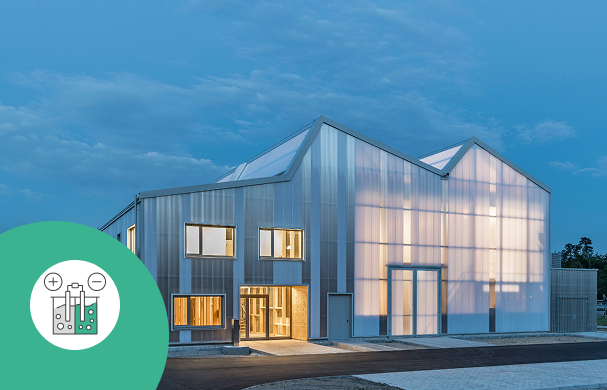
The project started on 1 April 2026 and will end on 31 March 2029. Germany’s path to climate-neutrality by 2045 significantly relies on green hydrogen. The two dominant technologies to produce hydrogen from water, Alkaline (AEL) and Proton Exchange Membrane (PEM), face limitations, in terms of cost, performance and reliability. Anion Exchange Membrane (AEM) electrolysis is emerging as a promising alternative, requiring less noble-metal catalysts than PEM and promising better performance in dynamics and efficiency. However, fully integrated AEM electrolyzer systems remain a research gap, particularly in experimental validation under realistic operating conditions.
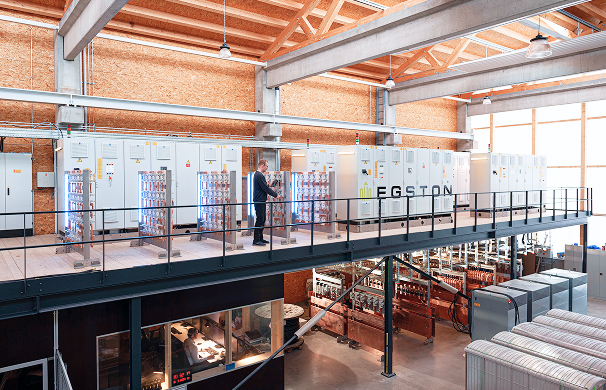
AEMflex project tackles this gap, by fully designing and building a modular 200kW AEM electrolyzer, including the full hydrogen processing chain. Tailored control strategies will be developed to optimize system operation in terms of stability, flexibility, efficiency and long-term reliability. Finally, the system is then validated through Power Hardware-in-the-Loop approach, simulating standard grid scenarios and non-standard events under realistic conditions.
The project’s final goals are both technical and scientific. AEMflex targets a capital investment cost below 400 €/kW, an energy consumption below 50 kWh/kgH₂, and a stack degradation rate below 15 µV/h per cell. On the scientific side, this project aims to develop design and control strategies for scaling and flexibility of AEM technology and explore AEM potential, to pave the way for next generations green hydrogen production technologies.
Workpackages timeline
| Work packages | Title | Timeline |
|---|---|---|
| 1 | Grid Requirements for Future Electrolyser Systems | 04.2026 – 09.2026 (6 months) |
| 2 | Conceptualisation, Specification, and Design of a Modular AEM Electrolyser System | 10.2026 – 03.2027 (6 months) |
| 3 | Control Development and Orchestration of the Overall Electrolyser System | 09.2026 – 06.2027 (10 months) |
| 4 | Design of Efficient and Modular Power Electronics | 09.2026 – 03.2028 (19 months) |
| 5 | System Modelling and Control Parametrisation of the AEMflex Electrolyser System | 03.2027 – 02.2028 (12 months) |
| 6 | Assembly and Commissioning of the AEMflex Electrolyser System | 08.2026 – 02.2028 (19 months) |
| 7 | Realistic Testing of the Overall System via Power Hardware-in-the-Loop | 09.2027 – 03.2029 (19 months) |
| 8 | Potential Upscaling of AEM Technology to Multi-MW Systems | 04.2028 – 03.2029 (12 months) |
Milestone
| Milestone | Timeline | Description |
|---|---|---|
| MS1 | Month 6 | PHIL validation benchmarks |
| TMS1 | Month 12 | Overall system design approved and full specification |
| MS2 | Month 17 | Control concepts and parametrised system simulation model |
| MS3 | Month 23 | AEMflex system built at the KIT PtX Lab and partially commissioned |
| MS4 | Month 33 | Full parametrisation of the electrolyzer simulation model |
| MS5 | Month 36 | Techno-economic scaling analysis and cost evaluation (LCOH model) |
MS = Milestone; TMS = Termination milestone
The AEMflex system is jointly developed by four partners. It brings together three core infrastructures in the Energy Lab on KIT Campus Nord:
- AEM electrolyzer system (KIT-IMVT, Bosch): A dedicated electrolysis system, designed and assembled by Bosch and KIT-IMVT, will be housed in a container at the PtX Lab. It includes the electrolyzer, composed of four 50 kW AEM stacks for a combined power of 200 kW, and the complete hydrogen downstream chain (water treatment, drying, compression). The system is engineered for full operational flexibility across the 10–100 % load range.
- Modular power electronics (KIT-ETI): Custom converters tailored to the AEM electrolyzer, enabling dynamic load control and modular stack switching.
- PHIL test environment (KIT-ITEP): The container is connected to the PHIL system in the SEnSSiCC building, where the AEMflex system is tested in real time under realistic grid conditions and grid disturbances.

“The AEMflex project lays the foundation for a sustainable green hydrogen future, with a real-world device showing how electrolysis can power the energy transition”
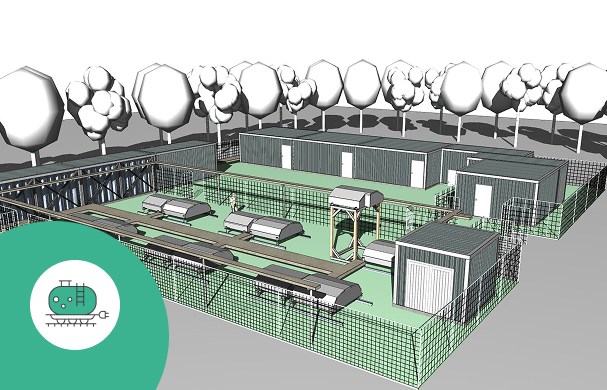
H₂Rail
H₂Rail realistically simulates a hydrogen powered locomotive in order to test fuel cells, batteries and energy management directly in the train.
H₂-in-the-Loop
H₂-in-the-Loop tests hydrogen-powered hardware under simulated power grid conditions in order to identify technical errors earlier and under more realistic conditions.
AppLHy
AppLHy explores how liquid hydrogen can be provided, stored and used, including in combination with superconducting components and drives.